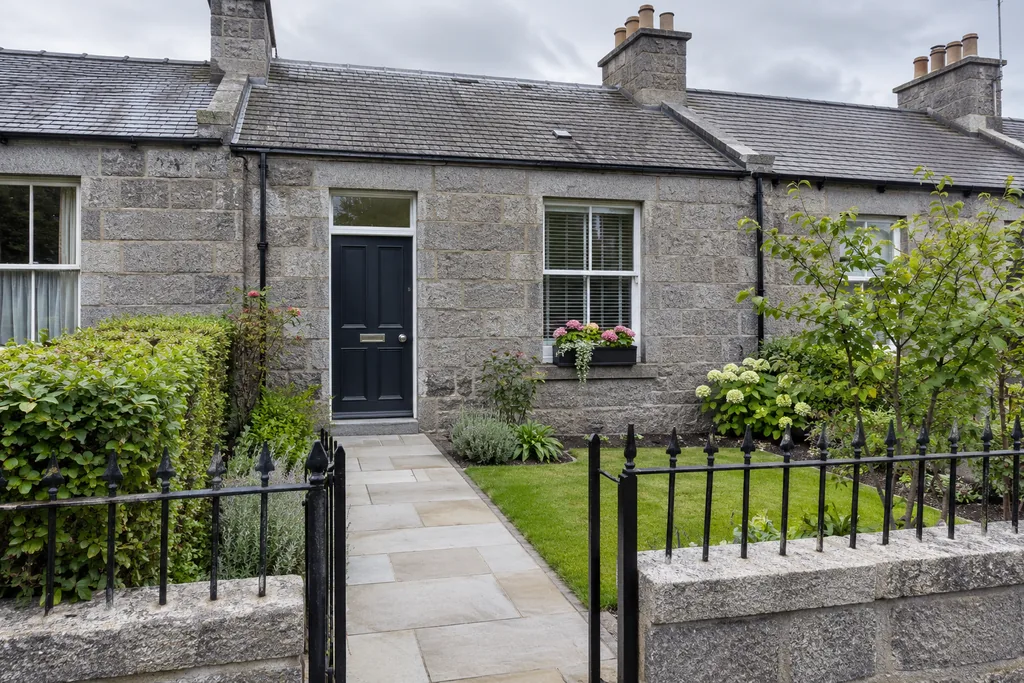
Why granite is awkward
Aberdeen's grey granite is hard to beat for looks, and hard to match. The Granite City got its name because local grey granite built so much of it, from the mid-1700s to the mid-1900s (Wikipedia, "Aberdeen", read 24 November 2026). The same stone has fine specks of mica that catch the light.
That is where trouble starts. A granite wall is not one grey. On a dry sunny day it looks pale and silvery. After rain it turns dark and cold. At dusk it can look blue. New paving that looks perfect under a shop's strip lights can look muddy or harsh next to it in daylight.
So the question is not "what looks nice?" but "what looks right here?" The wall, the roof slates, the front door and the gate all have a say.
Cool or warm: picking the colour
Start with the family of colours. Granite is a cool stone, so cool greys, silvers and light buffs usually settle in without a fuss. A pale sandstone with a creamy tone can soften a cold wall nicely.
A deep red or orange-brown sandstone can fight with grey. It may look heavy, and every time the sun goes in the contrast gets stronger. Very dark charcoal paving can also look harsh against pale granite on a small plot.
The most useful trick is simple. Ask for two or three sample slabs and lay them on the ground against your wall. Look at them in the morning, at noon and after a shower. Wet the samples with a hose. Choose the one that still looks good in the dull light that Aberdeen has for much of the year. Our sandstone and granite page shows the range of natural stone we talk through with customers.
Natural stone or porcelain
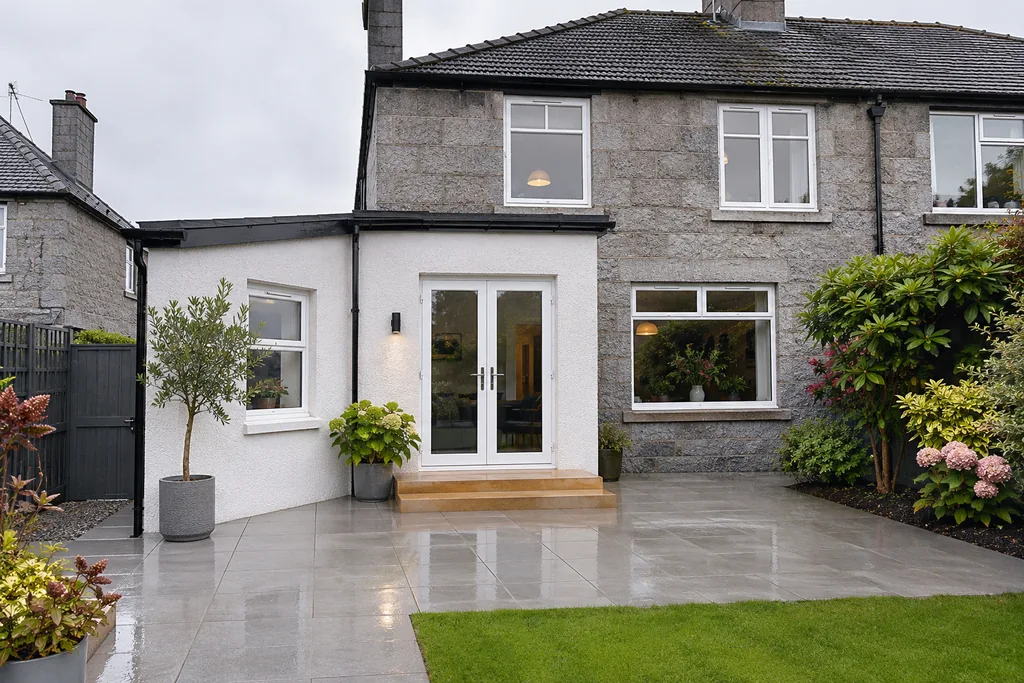
Natural stone has the best chance of looking at home beside a granite wall. Each slab varies a little, as the wall does. Sandstone is the usual choice for slabs, because it splits flat. Granite paving is possible, but it is very hard and works out costly to cut and lay.
Porcelain suits the newer parts of a granite house. If you have a modern extension or a back terrace outside patio doors, a slim pale-grey porcelain slab looks clean and takes moss and frost well. It is less convincing as a front path to a Victorian door.
A fair split for many homes is natural stone at the front, where the house faces the street, and porcelain or blocks at the back, where the garden is private and easy to keep.
Texture, size and pattern
Old granite streets were laid in small units: setts, kerbs and flags. Very large slabs can look out of scale in a short front path. A random mix of two or three sizes feels traditional. A single large size feels modern.
Texture matters for safety as well as looks. Riven sandstone and textured porcelain give grip in wet and frost. A polished or sawn face may look sleek, but it can turn slick under a film of moss or ice. We steer clear of smooth faces on paths and steps in this climate.
Keep joints tight and in a neutral colour. A pale jointing mortar next to a dark slab draws the eye to every line.
Edges, walls and steps
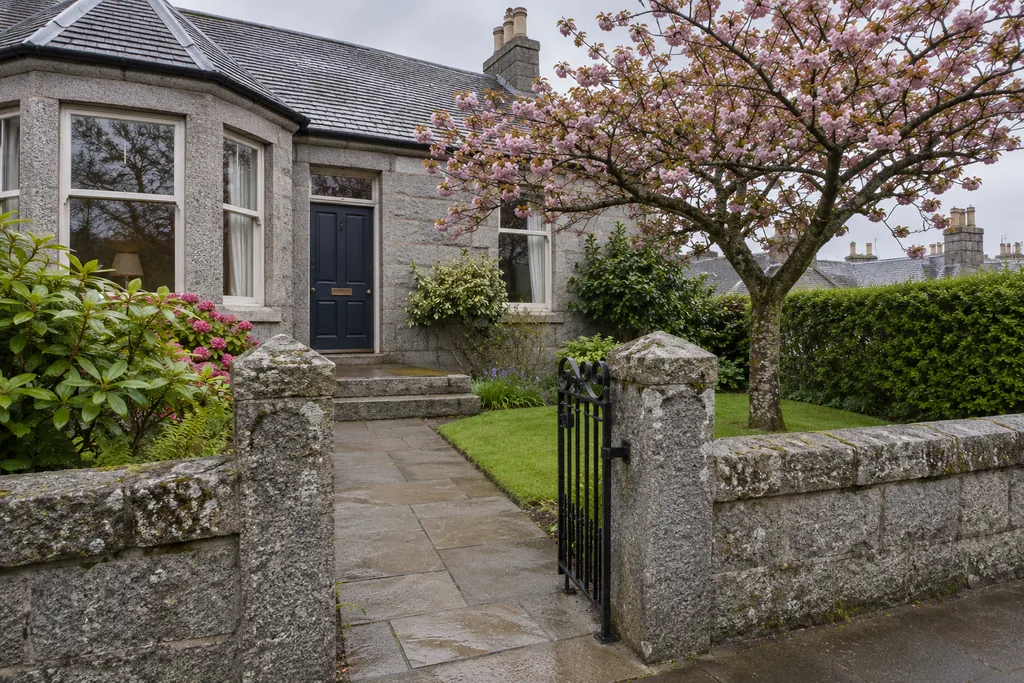
The edge is where new work meets old. If you already have a granite kerb, a step or a gatepost, keep it, and bring the new paving up to it with a neat, tight joint. A small band of granite setts round a patio picks up the character of local streets.
Leave a gap where water can drain between paving and the wall base. Old granite walls were not built with modern damp-proofing, so pooled water against them is a poor idea. The surface should fall away from the wall, with a small margin of gravel or planting if you can.
When steps are involved, keep the rise even and add a landing at the door. An uneven flight is the sort of fault you notice every day.
Care and salt
Granite itself barely changes. Sandstone is softer. In the salt air near the coast, it can dull and wear very slowly over many years. A brush and clean water are enough for most upkeep. A sealer helps some stones and not others, so ask the supplier for advice on the exact slab.
Moss grows in the shade of tall granite houses, especially where the sun never reaches. Textured faces hold moss more than smooth ones, so a stiff brush twice a year is part of the deal. Porcelain is the quickest to clean.
Council points
A path or patio at the back of a house is usually permitted development. The catch, according to the Government's page, is a surface between the house and a road, or a house in a conservation area or beside a listed building (mygov.scot, updated 18 November 2025).
Aberdeen City Council lists conservation areas that include Ferryhill, Marine Terrace, Old Aberdeen and Rosemount (council conservation areas page, seen 24 November 2026). Aberdeenshire Council says work on a property in a conservation area normally needs planning permission (council page, read 24 November 2026). Many of the best granite streets lie inside a boundary. A listed building also needs its own consent.
If you live in one, ask the council before choosing a colour or a boundary change. We will tell you what the work involves, and the council tells you what is allowed.
Questions
Will new sandstone ever match old granite exactly?
No, and it should not need to. Aim for a colour that sits well beside it in daylight and in rain.
Is porcelain a bad idea for a granite house?
No. It suits extensions and back gardens well. Natural stone usually suits the front of an older house better.
Do I need permission to change my front path?
Often not, but a conservation area or a listed house changes that. Check with the council.
Can granite setts be used in a garden?
Yes, as a border or a path edge. Ask us about stone paving.
How do I get a stone paving quote?
Ring 01224 927157, or use the form.