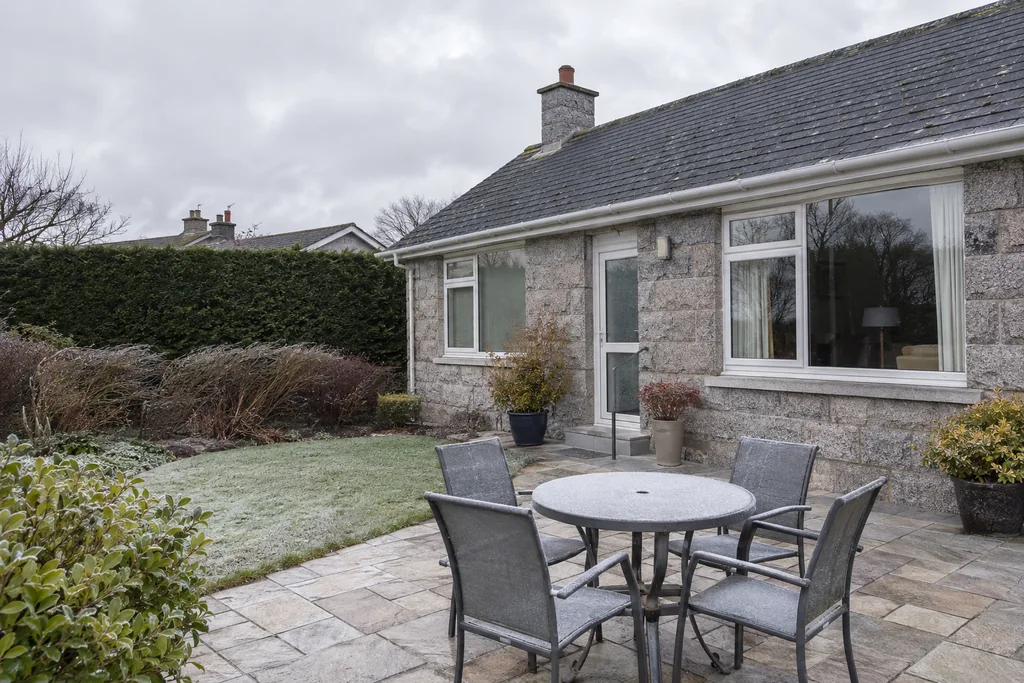
What the weather brings
Aberdeen sits between the mouths of the Dee and the Don, with the North Sea on one side. Wikipedia describes an oceanic climate with cool summers and mild, rainy winters, and says that, statistically, it is still the coldest city in the UK (read 24 November 2026). At Dyce, the average is about 832 mm of rain a year, on around 143 days with a millimetre or more (same source). It also puts snow at roughly 34 days a year.
Those are averages for one weather station, not your garden. A house on the coast or a hilltop has more wind. A sheltered back garden between granite terraces has less. But they give an idea of the job. Paving here faces rain on many days, a number of cold snaps and a steady breeze from the sea.
Frost: the slow damage
Frost damage is slow. Water gets into the base, the joints or the face of a slab. It freezes and expands. When it thaws, it leaves a tiny gap. Do that a few dozen times and slabs lift, joints open and edges flake. A cold snap that comes after a wet week does more harm than one in a dry spell, because the ground and the joints are already full.
The cure is simple to say and harder to do: keep water out. We do that by giving the surface a fall so rain runs off, by building a base that lets water drain through to the ground below, and by choosing slabs and blocks with a low water absorption. Ask the maker for the frost rating of the exact product you are buying. Do not rely on a sales assistant's word.
Rain and the base
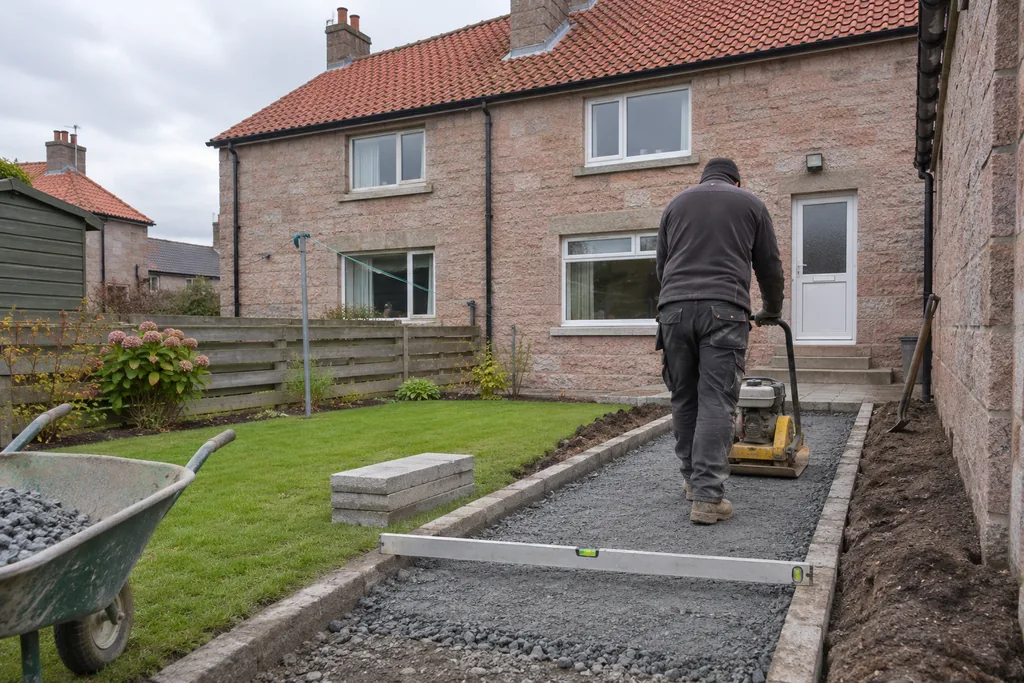
Rain is the other half of the story. A patio that holds a skin of water goes green, turns slippery and drips frost into its own joints. A fall of a small amount across its width is enough to send water away, and the surface should lead to a lawn or border, not to the house wall.
Under the surface goes the base. We dig out soft ground and build up hard stone in layers, pressing each one down before the next. On clay or wet ground, we add depth. A thin base is the main reason patios sink within a few winters. Granite terraces and old walls often stand on ground that drains slowly, so a patio beside one needs extra care over where the water goes. Our paving installation page walks through the order of work.
Salt and wind
Salt in the air is a gentle problem, and mostly a coastal one. On open ground near the sea, for example around Torry, Footdee or Stonehaven, salt spray can settle on paving. Hard, dense surfaces such as porcelain and granite barely notice it. Softer natural stones can dull and lose a little surface over a long time. It is not a reason to avoid sandstone. It is a reason to choose a good slab and to rinse the surface now and then.
Wind is more of a comfort issue. A patio with no shelter can be unusable on most days. It also carries sand and grit across the surface.
Choosing a surface
- Porcelain. The densest option. It takes almost no water and cleans easily. See porcelain paving.
- Block paving. Tough and flexible, with joints that move a little without cracking. See block paving.
- Sandstone and granite. Good-looking and long-lived. Pick a riven face for grip and talk through the care. See sandstone and granite.
Whatever you choose, a textured face is safer than a smooth one when it freezes.
Shelter that works
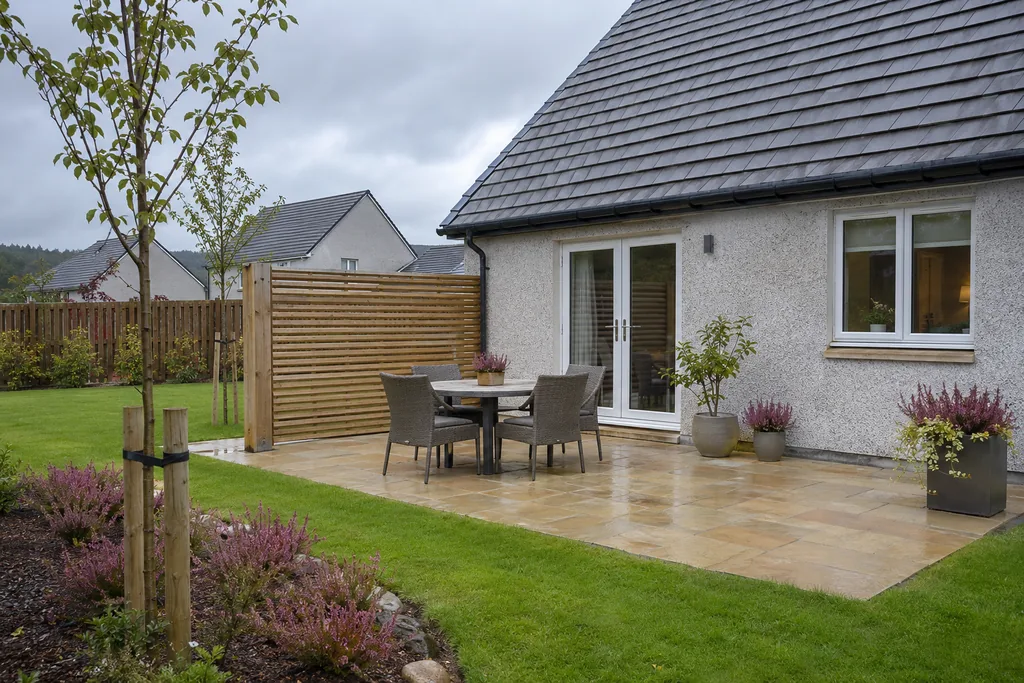
A solid wall seems the obvious answer to wind, but it can throw turbulence just behind it. A slatted fence, a hedge or a mix of planting slows the air instead of blocking it. That gives a calmer seat further out. Place the screen on the side the wind comes from most, which you will know from your own washing line, and leave the sunny side open.
If you plan a screen, think about it before the paving goes down. Post holes are far easier to dig before the slabs are laid.
Winter care and timing
Brush snow off rather than hitting it with a shovel edge, which chips slabs and blocks. Be careful with rock salt and de-icers: some can mark or wear certain stones and joints, so check the maker's advice for your paving. Sweep leaves in autumn, since a damp layer feeds moss.
On timing, we avoid laying in hard frost or heavy rain. Bedding mortar needs to set, and slabs must sit on dry material. A good contractor will say, "not today", and mean it. If your patio is for next summer, an autumn or winter booking can be fine, as long as the day is right.
If you are in a conservation area, or the surface faces a road, check with your council before work (mygov.scot, updated 18 November 2025).
Questions
Will salt air ruin sandstone?
Not quickly. Very slowly, if at all. A good grade of slab and the odd rinse are normally enough.
What is the best surface for a windy, wet site?
Dense surfaces such as porcelain and hard blocks give least trouble. Natural stone is fine if it is a good grade.
How thick should the base be?
It depends on the ground and the use. A patio needs less than a car park. We would measure and say on site.
Can you lay a patio in January?
On a good day, yes. On a frozen or soaked one, no.
Who do I ask about a coastal patio?
Call 01224 927157 for a patio price. The patios page and the form are there if you prefer.